All posts by Dustin (Oneman)

Reading Ward Churchill After Eichmann

In the wake of Ward Churchill’s firing from Colorado University and his subsequent decision to sue for reinstatement, I’ve been thinking a lot about how (and, I admit, whether) to read Churchill’s work in the wake of revelations (or allegations, depending on your point of view) of academic dishonesty including plagiarism, fraudulent claims of Indian identity, and shoddy use of (or misuse of) historical sources. Some of the claims lodged against Churchill push to the edge of absurdity, including the use of articles ghostwritten by himself to support claims made in other articles.

For those who have been sleeping off a bender these past few years, here’s the story. Continue reading

Is It Paranoia if Everyone Really Is Out to Get You?

This article in Inside Higher Education, which comments on a survey showing that more professors today feel their academic freedom is threatened than did during the McCarthyist era, is the kind of thing you’d expect me to have a lot to say about.

Gross surveyed social science professors last year about whether they had felt that their academic freedom was threatened, and found that about one-third did. In 1955, Paul Lazarsfeld, the late Columbia University professor, did a similar survey and found only one-fifth of professors feeling affected by attacks on their academic freedom.

However, I’m going out of town with my family in a little over an hour and won’t be back until the weekend, so I don’t have time to comment on it very fully. So here’s your assignment: imagine what you think I’d say about it, and then argue over what you’ve imagined in the comments.

Thanks — you’re a lifesaver!

Ota Benga Revisted

In a case of history repeating itself (this time as farce?), a Congolese zoo played host to a troop of “Pygmy” musicians (I’m assuming Mbuti). But it’s ok, it’s not discrimination. Really:

“It’s not a case of discrimination,” said Yvette Lebondzo, the director of arts and culture for the Republic of Congo. “We lodged them in the park near running water and a forest simply because that will remind them of their usual surroundings — which is the forest.”

I suppose they work just as hard to find culturally appropriate housing for other visiting world musicians — coke dens for American boy bands, teepees for American Indians, yurts for Himalayan techno groups, etc.

[Via BoingBoing]

No More Discipline Issues in MY Classroom!

This is wrong on so many levels: Nevada has authorized the public university system — two of whose schools I teach in — to train professors and enlist them as “reserve police officers” to respond in case a VA Tech-style shooting breaks out here. Now, I’ve known a few police officers in my time — it’s a full-time discipline requiring an awful lot of on-the-ground experience to be able to make the kind of snap decisions that are demanded of real security work. Security expert Bruce Schneier has pointed out that the best security comes from trained experts that recognize and act on situations that feel “hinky” — not pulling aside every dark-skinned person in the airport, but pulling aside the handful of people who act slightly “off”. Developing this kind of sense, and then recognizing what it means and how to respond to it, takes experience and a certain mindset — which the Board of Regents apparently feels can be developed next to a 4-4 courseload, committee service, office hours, research, professional development, course development, and so on. They must be drinking the Horowitz Juice — that strange brew that convinces people that full-time profs (and adjuncts like me who carry a full-time, or more than full-time, courseload) are only working 15 hours a week and have plenty of time to devote to learning to be security experts on top of teaching.

It’s an insult to both professors and police officers, especially since we all know that the training Nevada’s “reserve police officers” receive isn’t going to be anything like what I’ve described above — neither time nor money are available for anything like that. Instead, I’ll lay odds that the “extensive training” will consist of an hour or two of basic firearm safety and police procedure (e.g. how to make an arrest and detain someone until the real police arrive) and a time requirement in a firing range. In effect, this policy will provide a ready source of guns on campus, under the protection of poorly-trained non-experts who are more at home with the intricacies of 17th century poetry or the esoterica of subatomic physics than with the demands of real security.

This is offered as an alternative, of course, to real policing, real governance, which would require either passing a new tax to increase police forces (which was voted down in referendums during the last couple elections; I should note that Nevada doesn’t have a state personal or corporate income tax) or increasing the gaming tax that casinos pay and which accounts for about a third of the state’s tax revenues (which of course the casinos that own Nevada would never stand still for). In other words, the state is offering up a classic example of what Schneier calls “security theater” in place of, you know, security.

And I’ll bet it’s coming soon to your state…
The Fate of McFate: Anthropology’s Relationship with the Military Revisited

Back in January, Matthew Stannard at the SF Chronicle, having come across my SM piece Anthropologists as Counter-Insurgents, contacted me about doing an interview for an upcoming profile on Montgomery McFate, the advocate for anthropology in the military whose work I was responding to. The piece is now online, entitled Montgomery McFate’s Mission: Can one anthropologist possibly steer the course in Iraq?. I’m not quite ready to revisit this topic — I’m up to my neck in grading and other work, with the semester’s end a week-and-a-half away, but I thought I’d mention it now while I put together some further thoughts on the matter. It’s a fairly good article, even though I’m only quoted once (Stannard apparently has not been taught the maxim that the more quotes of me a paper has, the better it is). Interestingly, though the interview ranged all over, I’m quoted more in my capacity as historian of anthropology than in my — I think more relevant — role as anthropological ethicist.

More Friday Funnies: Occupational Hazards

The Onion has a story I think we can all identify with: Archaeologist Tired Of Unearthing Unspeakable Ancient Evils. Like Edward Whitson, the interviewee, I find lightning-breathing ocelots to be one of the recurring annoyances of anthropological fieldwork.

“All I wanted to do was study the settlement’s remarkably well-preserved kiln,” said the 58-year-old Whitson, carefully recoiling the rope he had just used to clamber out of a pit filled with giant rats. “I didn’t want to be chased by yet another accursed manifestation of an ancient god-king’s wrath.”

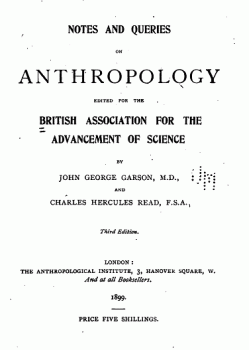
Notes and Queries on Anthropology

Notes and Queries on AnthropologyGoogle Books now makes it possible to download pdf’s of public domain works, like this copy of our namesake Notes and Queries on Anthropology (1899). Alas, the text — which Google must have a plain-text version of in order to do keyword searching — seems not to be embedded in the pdf file. Here, to the best of my typing ability, is a little taste of “Notes and Queries” to whet your appetite:

It is almost impossible to make a savage in the lower stages of culture understand why the questions are asked, and from the limited range of his vocabulary or of ideas it is often nearly as difficult to put the question before him in such a way as he can comprehend it. The result often is that from timidity, or the desire to please, or from weariness of the questioning, he will give an answer that he thinks will satisfy the inquirer. If time serve, these difficulties can easily be overcome by friendly intercourse, and a careful checking of answers through different individuals (87 – 88).

Needless to say, this work is of historical interest more than practical interest. Still, it’s good to see this history preserved and available; I also downloaded a copy of Franz Boas’ The Mind of Primitive Man (1911), which is of rather more interest to me.

There is no “master list” of downloadable texts, or search flag that will return only results that have pdf’s attached. The trick is to click the “Full View Books” radio button under the search form, and then hope. In “Advanced Book Search”, you can set a date range — I’d think that limiting the publication date to years before 1925 would be a good idea, as current copyright law only covers back to 1926 or so. But, of course, there is public domain work published after 1926 — anything published by the US government, for example — and there is still some material that was published earlier that may not be public domain (e.g. works in translation, where the rights are/were held by various parties and now nobody’s quite sure who owns what).

Imagine if we had some sort of reasonable copyright laws — we could access much more recent scholarly work, most of which is locked up in the storerooms of university libraries where nobody will ever see it.

Making Better Students

Some time ago, I asked how we could help our students make up for the widely-lamented lack of studying skills — and just plain living-as-a-student skills — they bring to college with them. Since then, I’ve been thinking more and more about this problem, as I’ve grappled with some of the deficiencies and ineptnesses that seem to be breeding like rabbits among my students. Over the break, I decided that I needed to commit myself to bringing some of the studying and learning skills that those of us who have achieved higher degrees have picked up along the way, making explicit things like how to write a research paper but also how to organize one’s time or how to learn leadership.

One result of this is a new site I put together during the intersession, entitled Being Better Students. The basic idea is to collect (and, occasionally, author) good, solid, and doable tips for students — things that they can read and immediately go and do to help them wrap their heads around what should be very high demands on their time and energies. Now that I’ve started to accumulate a decent amount of material, I’d like to invite Savage Minds readers (and writers) to have a look and let me know what you think — and especially let me know what works for you or your students. I’d be happy to accept guest posts, or to repost information sent privately, or whatever, so long as it’s practical and useful.

Hopefully, the site will help encourage professors to take on some of their own students’ short-comings — I’ve gotten a little tired of colleagues telling me that I had to work around these problems instead of helping my students face them down. Hopefully, too, there will be information from time to time that’s new to some of us “students-for-life” — it’s never too late in your academic career to become a better student!

Call for Help: Case Study Recommendations

If I haven’t seemed like my normally garrulous self lately, it’s because what with teaching 5 classes, editing a book, and writing a dissertation, I’ve been a little low on though-juice. Because one can never have too much to worry about, though, I’ve taken on a new class for the Spring, People and Culture of the World, which is what it sounds like (this is at the community college level, by the way). Since I wasn’t actually told about this until the Spring catalog came out (said my chair, “Oh, didn’t I tell you?”) I’m under a lot of pressure to get book orders in. I’ve got a textbook selected (John Bodley’s Cultural Anthropology: Tribes, States, and the Global System, though I’m also trying to get a review copy of Core Concepts in Cultural Anthropology to use when I teach the class again) but I could use some help selecting a couple of short(-ish?) case studies — 2 or 3 books around 150 pages to supplement the shorter cultural descriptions in Bodley’s book. I’d like one of these to deal with a Muslim culture, especially (though not necessarily) if it deals with gender; then I’m thinking either a foraging people or South Pacific horticultural group, and maybe a minority subculture in a polycultural industrial state. Since I don’t really have time to go through the full process of requesting a dozen or so exam copies to review, waiting for them to arrive, and carefully evaluating them, I’m hoping that the collective wisdom of the Savage Minds collective can point me in the right direction — at least to help me narrow my choices down so I don’t waste time on outdated, unteachable, or poorly written ethnographies.

So how about it — any suggestions? Also, as long as we’re on the topic, what do you think of these kinds of works, you know: those short books clearly intended for introductory-level classes? What other sorts of books do you think might be appropriate for this sort of class? And how do you go about evaluating texts for your classes (if you’re a teacher of some sort, that is)? What are you looking for, and how do you know when you found it?

A Reponse to “The Nutty Professors”

My colleague Richard Senghas, an anthropologist at Sonoma State University, sent me this email in regard to the New Yorker article mentioned by Kerim last week. His take on Grafton’s “The Nutty Professors” is rather less forgiving than Kerim’s, but I think he makes some very important points that are worth considering, so I asked him if I could post it here. The text is slightly edited to remove the “emaily” parts (and he’s approved the changes). Continue reading

Some Hard Truths About College

When I started teaching, I had a somewhat idealistic view of my students. I thought that if I respected their adulthood — that is, accomodated their autonomy by keeping rule-making to a minimum — they would respond as, well, as adults. So, for instance, I made it clear that attendance was not a requirement and did not keep roll. The (predictable) result: low attendance. After quite a bit over half of my students failed their mid-term, I realized that I’d made a terrible mistake, and now, despite my distaste for the necessity of the task, I take roll and include attendance as a part of the final grade (usually about 5%).

What went wrong, aside from my own inexperience and naivité? In the three years since I first stepped into a classroom as a teacher and not a student, I’ve come to realize that most of my students simply have not been informed of what it means to be a college student. Some view it as an extension of high school, expecting me to be an authority figure and punisher of wrong-doing, and resenting the situation just like they did in high school; others follow a similar line, seeing college as high school without any authorityfigures, so they can do whatever they want. Very few of my students have seemed to have much of a sense of what real learning — the kind of life-long commitment to the development of their minds that college kicks off — entails, nor do they have very real understandings of what the expectations of college learning are. Continue reading

In the Flesh in the Museum

Representations of Indians in American Natural History Museums

Preface: The recent posts on Ota Benga and the popular museum reminded me of an essay I had wanted to post last year when Kerim posted about the Bavarian village in display in Africa. I had prepared it for posting last year, but for some reason never did. The essay deals with the display of living people, and particularly native North and South Americans, in ethnographic/educational contexts — not the sideshow, but the museum and the culture fair.

“There are Indians in the Museum of Natural History,” writes Danielle LaVaque-Manty (2000: 71) “And there aren‘t any other kinds of people.” The particular Museum of Natural History LaVaque-Manty is speaking of is the Ruthven Museum of Natural History at the University of Michigan, but she could easily be describing any number of natural history museums throughout the United States—the American Museum of Natural history in New York City, the Smithsonian in Washington, DC, the Peabody Museum at Harvard, the Phoebe Hearst Museum in Berkeley, the Field Museum in Chicago, and so on. Since their respective inceptions, mostly in the latter half of the 19th and the first half of the 20th centuries, the American natural history museum has played a privileged role in the presentation and representation of American Indians1 to an American public largely defined in ambiguous counterpoint to the savage mannequins held at bay behind the plate glass of the museum display. Whether cast as the noble Redman sadly disappearing before the onslaught of civilization or as the savage heathen to be forcibly converted or eliminated entirely, the removal or disappearance of American Indians was a necessary prerequisite to the occupation by white settlers of the American land. The museum became, oft times literally so, the last refuge of the “wild” Indian, at the same time that the possession of the Indian in the museum came to stand for exactly the possession of the land that made the “wild” Indian an anachronism, an echo of a time not before the settlers came, but of a time entirely removed from the history of America, a time when America was, indeed, an entirely different and new world.

This paper deals with the presentation of Indians in the American museum. Continue reading

RSS on AnthroSource

I’m not sure if anyone’s mentioned this, but in June AnthroSource added RSS feeds to each of their journals, piping tables of contents to you when each new journal comes out. This seems pretty neat, although the feeds are wacky — each post includes the title and the bibliographic details (a handful include snippets from the front of the article, though I can’t figure out why those rare few are selected for special treatment). This could be useful to some folks, I suppose, but… If your reader is set up to open the page directly, though, it becomes more useful — you go to the citation page in AnthroSource, where there’s an abstract if available and links to the PDF or into JStor. A bit kludgy — here’s what it looks like for me: FeedReader displays feed, I select post, Feedreader displays post I click headline, FeedReader displays citation page, I click PDF link, FeedReader opens login page in Opera, I log in, pdf opens in Opera. The feed I tested doesn’t link to J-Stor, but you can guess for yourself what extra steps that would take.

I’d like to see full-text, or at least full abstracts, in the feed itself, along with a deep link to the PDF. That would be useful. It can’t be all that hard to add validation to the feeds — my RSS reader allows me to add a username and password, so it must be possible within the standard. I’d also like to see RSS-ized searches — that would be awesome! (For that matter, I’d like to see Google add RSS to searches outside of their blogsearch ghetto — I guess that’s a bit off-topic, but in case they’re reading this….) AnthroSource isn’t serving up ads, so they have no interest in keeping me (or you) coming back to their site — the site should be a framework for serving up information (on demand, just in time… where have I heard this before?).

I kvetch ’cause I love, though — RSS is a good step for AnthroSource.

Boas and the Popular Museum

I discovered a neat, fairly new blog dedicated to museums today, S.J. Redman’s Museum Madness. Redman’s most recent post addresses an interesting and (for me, anyway) new aspect of Boas’ museum work, his populism.

Most of us are familiar with the relationship between Boas and museums — the ethnographic exhibits at the Columbian Expo in 1893, his early curating work at the Field Museum, his move to the American Museum of Natural History and his involvement with the Jessup Expedition to the Pacific Northwest and Arctic coast that stocked much of the AMNH’s collection. Along with his 1889 article On Alternating Sounds (AnthroSource link), Boas’ critique of exhibition schemas that reflected the prevalent evolutionary beliefs of the time were a crucial early step towards his later cultural relativism, as was his insistence on supplementing material artifacts (shields, pots, spearheads, matates, etc.) with folklore, songs, and other non-material “artificats” (recipes, instructions, game rules, etc.) in order to create a fuller understanding of a culture “from the native’s point of view” (rather than as a pitstop on the march towards us-ness).

Redman focuses here on Boas’ role as a museum professional, though — not as an anthropologist. Continue reading

Living and Teaching in the Information Economy

I received a strange piece of advice recently. As… well, as nearly everyone knows, I’ve been struggling to finish my dissertation for a couple of years. Between personal crises, departmental woes, and a struggle to make a livable income, I just haven’t been able (or, to be honest, as willing as I’d like) to put the time in I need to finish the damned thing. So I’m talking to a colleague back east, a well-respected anthropologist who is, nonetheless, not attached to any academic institution, and he asks me if teaching is what I really want to do.

“Yes, it is,” I reply. “I love teaching.”

“Well then,” he says, “maybe you should give some serious thought not finishing your dissertation, to not finishing your PhD.”

(Not actual quotes, of course – just roughly what was said.)

His logic was this: Continue reading